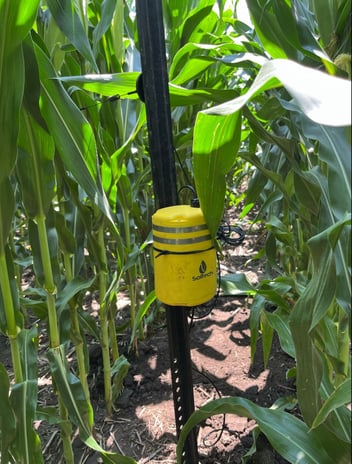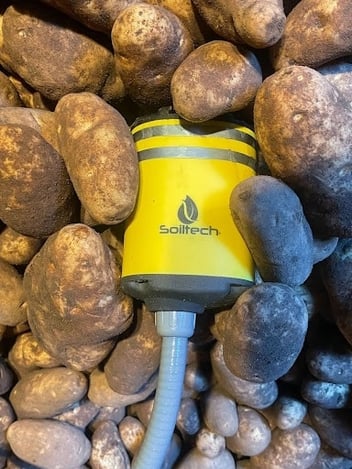
Big news from the field: the Soiltech Beacon now speaks LoRaWAN, and it's kind of a superpower.
If you’ve ever tried to get a sensor online where cell bars disappear and Wi-Fi barely reaches the shop door, you know the struggle. LoRaWAN (short for Long Range Wide Area Network) changes that story. It’s a type of radio network built specifically for low-power, long-range, intermittently connected devices—like the sensors that live near your crops, pivots, or fence lines.
Now, your Soiltech Beacon can speak that same language.
LoRaWAN in a Nutshell
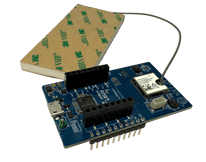 Think of it this way: LoRa is the radio, and LoRaWAN is the network that lets many LoRa devices talk to a gateway, which then sends data up to the cloud.
It’s like Bluetooth’s rugged cousin—built for open fields instead of office buildings—and it can run a marathon on a single granola bar.
To use LoRa, you will need to use either your own or a public LoRaWAN hotspot or gateway, similar to a WiFi Router.
Why Growers Should Care (In Plain Dust-on-Your-Boots English)
Because coverage matters more than anything.
With LoRaWAN, the Beacon can check in reliably from those hard-to-reach corners—valleys, back fields, or spots where cellular coverage just doesn’t cut it. Reliably better signal and fewer blind spots.
In short: LoRaWAN = long-range, low-power connectivity that keeps working where cellular and Wi-Fi give up.
How Far is "Long Range", Really?
Under good rural conditions with proper deployment, LoRaWAN signals can travel miles.
With smart antenna placement, it’s not unusual to see ranges of up to nine miles between a gateway and your devices. Terrain and setup matter, but the key takeaway is simple: you can cover a lot of ground with very little power.
The Party Trick: Whispering Below the Noise Floor
Imagine you’re at a roaring concert. Most radios would have to shout to be heard.
LoRa can whisper.
Thanks to clever modulation (think: advanced signal math), it can send and receive very faint signals—even below the noise level—and still get through. That’s how it earns its “long-range, low-power” reputation.
What Changes for Beacon Owners?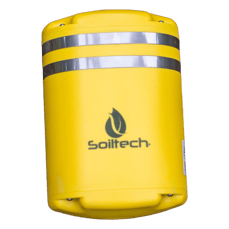
- More places to connect: Remote blocks, long pivots, and tree lines are finally in range.
- Less power draw: Built for low-power sensors that wake up, report, and go back to sleep.
- Same Beacon, new superpower: The LoRaWAN module is an add-on, so existing Beacons can be upgraded easily
A Quick Field Picture
Place a LoRaWAN gateway on your shop roof, grain leg, or tower, and your Beacons can check in from areas that used to be total dead zones. One gateway can cover a wide radius, keeping your Beacons light, battery-friendly, and talkative only when they need to be.
What you'll need:
- A LoRaWAN network or gateway (your own or an existing public one) within range
- The Soiltech LoRaWAN add-on module for your Beacon, compatible with both new and existing units
Fast FAQ
Is this only for new Beacons?
Nope. The module can be retrofitted onto units already in the field.
Does it replace cellular?
Not necessarily—it’s another tool in your connectivity belt. Perfect for places where cellular or Wi-Fi don’t reach.
Will it drain my battery?
No. LoRaWAN was built for low-power devices—it’s an ideal fit for long-life sensors.
Nine miles, seriously?
In wide-open rural conditions with smart setup, yes. Terrain and antenna height will affect results, but long range is the point.
The Bottom Line
LoRaWAN turns the Soiltech Beacon into a long-range, low-power communicator that can whisper through noise and still be heard.
More connected acres. Fewer blind spots. Less fuss.
If your fields like to hide from connectivity, this is your solution.
Add the module, set up a gateway, and let your Beacons talk quietly from miles away—no shouting required.
👉 Interested in learning LoRa or seeing Beacon data in action? Schedule a quick demo with Tyson Backer and learn how Soiltech can support your operation from soil to storage: https://meetings.hubspot.com/tyson-backer